If your podcast has dozens of episodes but isn’t generating clients, leads, or enquiries, the problem might not be your content, it could be your distribution strategy. Turning an audio-only podcast into a video podcast can help you reach new audiences, improve discoverability on YouTube, and transform every recording into multiple content assets, including YouTube videos, short-form clips, and social media posts. In this guide, we’ll explain why podcasts struggle to convert listeners into clients, how video podcasting can increase visibility and engagement, and how to repurpose podcast content into a consistent content marketing strategy that builds trust and generates business opportunities.
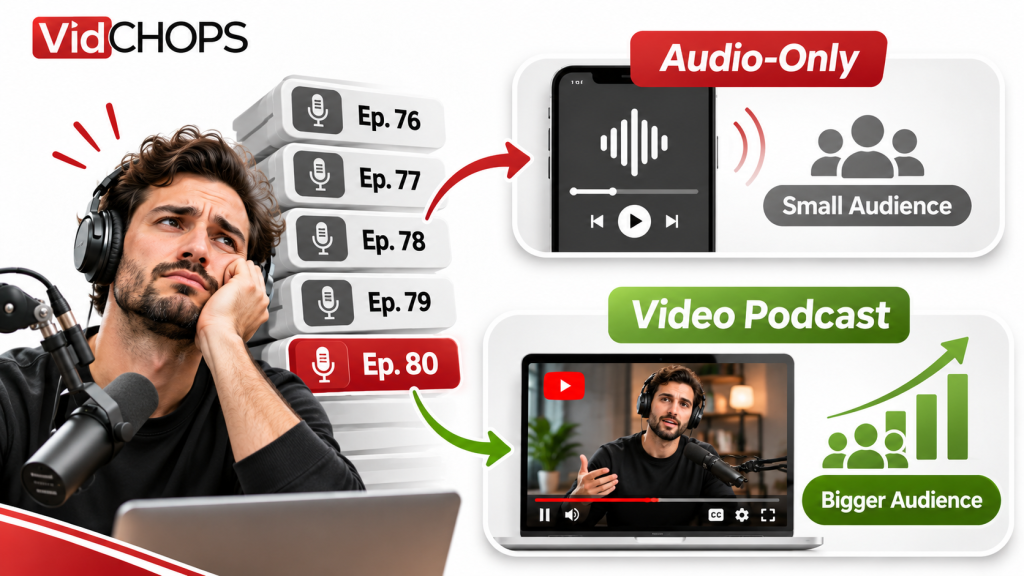
Somebody emails you. They’ve got a podcast. They’re proud of it — 80-odd episodes, a decent guest list, a small but loyal audience who write in and say nice things.
And not one client. Not one enquiry. Not one person who’s said “I found you through the podcast.”
So they ask the obvious question: is this a waste of time? Should I stop?
Here’s what I tell them, and it’s the same thing every time: your podcast is probably the most valuable content asset you own, and you are publishing it in the one format that can’t be discovered.
That’s not a content problem. That’s a distribution problem. And it’s fixable in about three weeks without changing a single thing about your show.
Let me show you why it’s happening.
You put your best work where nobody can find it
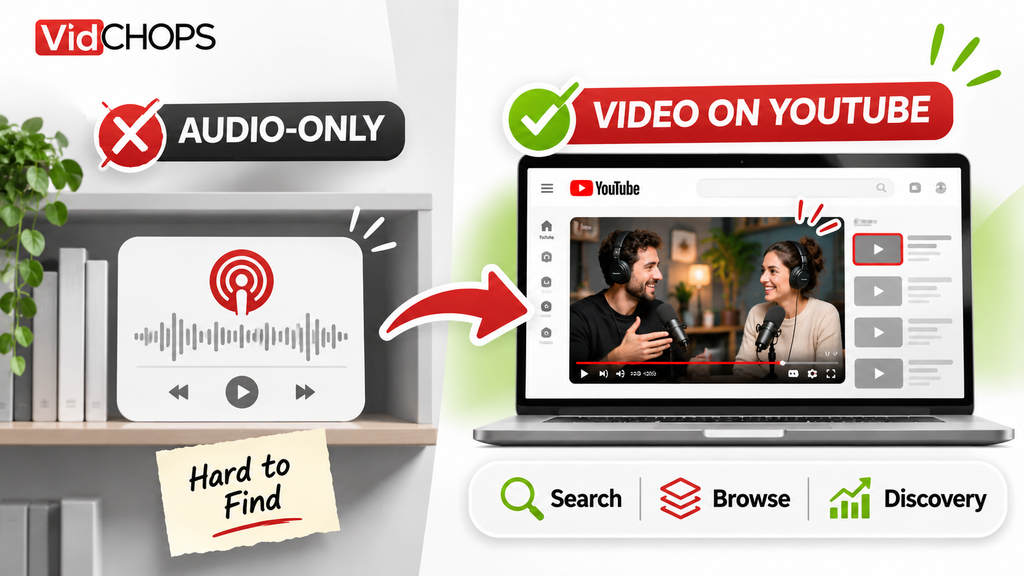
A podcast is a search-poor, discovery-poor format. Audio lives in apps where people go to listen to shows they already know. There’s no browse feed serving your episode to a stranger, no thumbnail competing for a click, no algorithm testing your hook against an audience of millions.
Meanwhile, the video version of that exact same conversation — the one you’re already recording, in a room, with a microphone, on a laptop or a camera — sits on a shelf.
This is the part that should sting. You are already doing the hard part. The booking, the prep, the hour of conversation, the edit, the show notes. All of it exists. You’re just shipping it in a container that can’t travel.
The data on where podcast audiences actually are has shifted hard, and most podcasters haven’t noticed.
And here’s why it landed there. YouTube’s viewing has moved to television — Galloway’s client dataset shows TV viewership going from roughly 23–24% in 2021 to over 50% by 2025. Average long-form video length is up 51% since 2020 across 100 billion views of data. Average view duration is up 77% in four years, from 4:35 to 8:00.
Think about what those three numbers mean together. People are sitting on their sofas, watching longer things, watching them for longer. That is a podcast. A 60-minute conversation is not a stretch on a 55-inch screen — it’s exactly what the room is built for. It’s a stretch on a phone in a car, which is where podcasters assume everyone is.
So the audience has moved to you. You just haven’t moved to them.
The chart that explains the gap
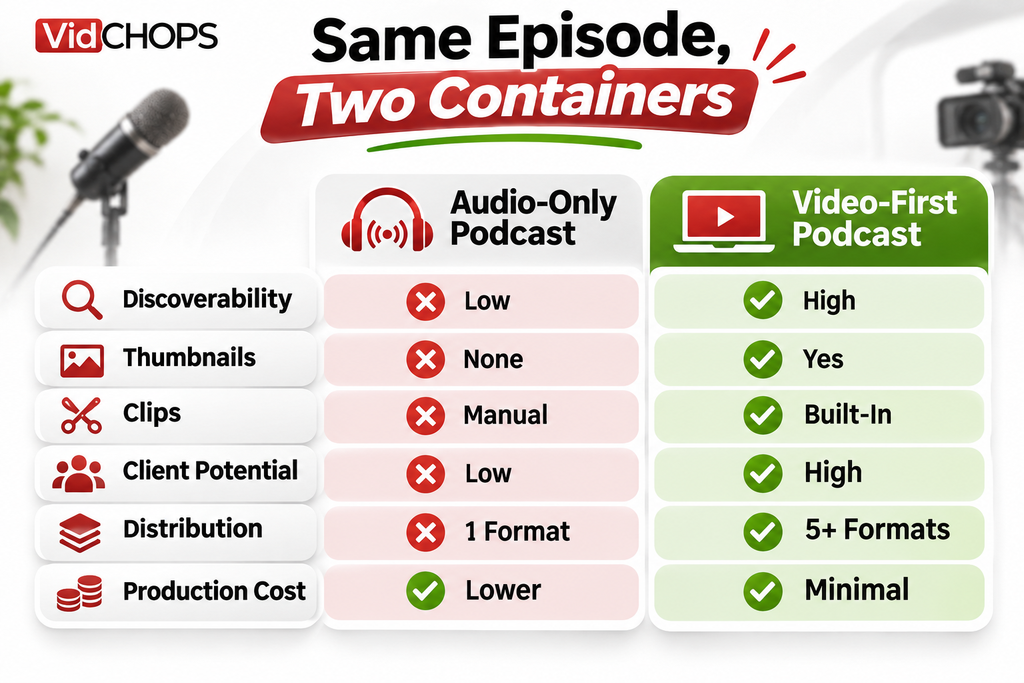
Chart: “Same Episode, Two Containers”
| Audio-only podcast | Video-first podcast | |
| Discoverable by strangers | Very low — app charts only | High — browse, suggested, search |
| Thumbnail competing for clicks | None | Every upload |
| Clip production | Manual, awkward | Native, already framed |
| Client-generating potential | Low | High |
| Cross-platform distribution | 1 format | 1 recording → 5+ formats |
| Marginal cost of going video | N/A | A camera and a framing decision |
Analytical model based on VidChops production experience. Label as a VidChops model, not a study.
Now compare that to what you’re actually getting paid for. You sell an hour of your expertise, once. It produces one audio file. That file might reach a few hundred people who already know you.
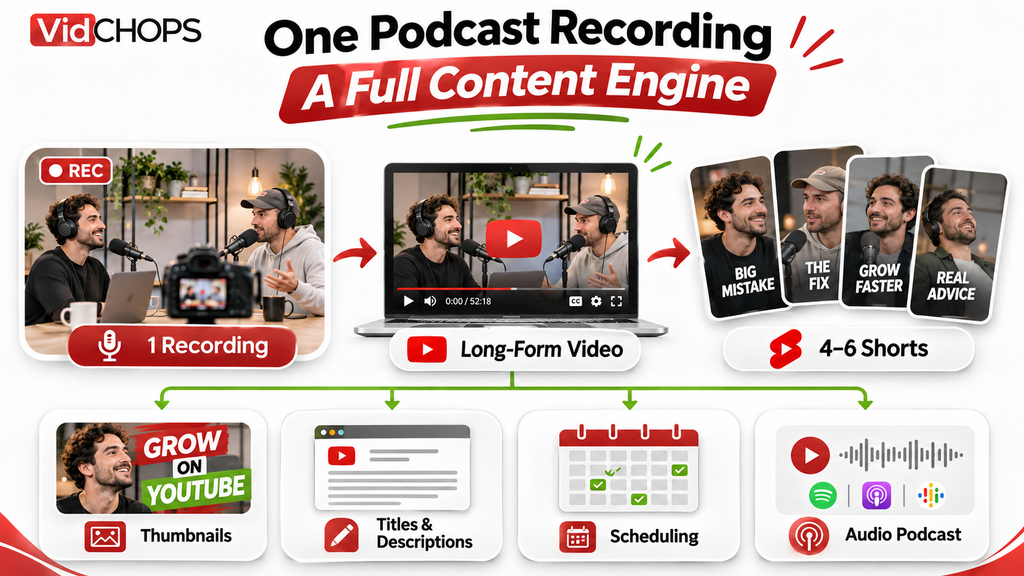
Or: that same hour produces a 50-minute YouTube video, four to six vertical clips, a written summary, and a set of social posts. The recording is the raw material. Everything else is extraction.
That’s the entire argument. You’re not short of content. You’re short of extraction.
The three reasons podcasts don’t convert (and the fix for each)
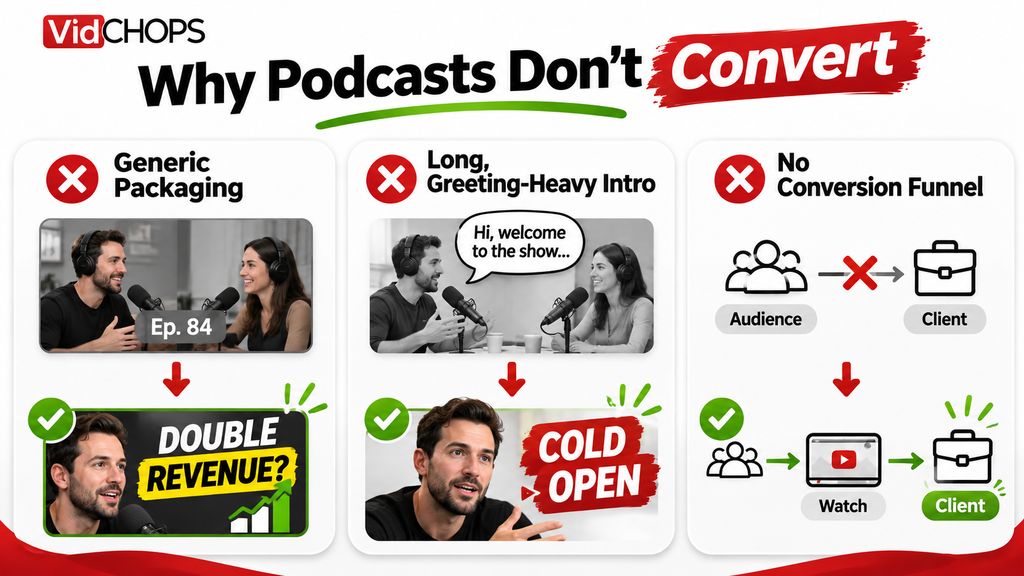
Failure one: you’re packaging a podcast like a podcast
Open YouTube and search your topic. Look at the podcast thumbnails. Most of them are two people at a table, shot wide, with the show’s logo in a corner and a title like “Ep. 84 — Building a Business with Sarah Chen.”
Nobody clicks that except people who already know Sarah Chen.
A thumbnail has one job: be understood in a glance, by a stranger. Your episode needs a claim, not just a subject. Not “Ep. 84 — Building a Business with Sarah Chen” but “She Grew to $2M by Saying No to Every Client for a Year.”
Same conversation. Completely different click rate.
The fix: Write your title and thumbnail before you record. If you can’t articulate a claim compelling enough to click, the episode probably doesn’t have one — and you’ve just saved yourself an hour. Then film to that claim.
Failure two: your first 30 seconds are a greeting
Most podcast videos open the same way: intro music, the host explains who the guest is for 90 seconds, then “hey, welcome back to the show.”
The viewer clicked because they wanted the claim in the title. You’ve given them a handshake instead.
The best-performing podcast format in the world right now — Chris Williamson’s Modern Wisdom — often just opens on a question. No welcome, no housekeeping, straight into the conversation. The Diary of a CEO approach is the opposite extreme: a produced sizzle reel that proves what’s coming before the episode starts. Both work. The “hey guys, welcome back” approach does not, and neither does a 40-second channel intro.
The fix: Open on the sharpest 15 seconds of the conversation, then a three-second cold open naming the claim, then into the show.
Failure three: there’s no funnel, so there’s no conversion
Here’s the uncomfortable one. Even if all of the above is right, a podcast won’t generate clients unless it’s built to.
Augie’s three-tier model holds up: attention content gets people in the door, trust content makes them believe you know what you’re talking about, conversion content makes it easy to act. A podcast naturally sits in the middle tier — it builds enormous trust. But most podcasters never make the two tiers around it, and never tell anyone what to do next.
The fix: Every fourth or fifth episode, close with a direct CTA. Not every episode — that gets repetitive and pushes people off-platform. But regularly enough that the option is visible. And build the two adjacent tiers: short clips for discovery, one or two case-study videos for conversion.
The conversion guide: audio-only to video-first in six steps
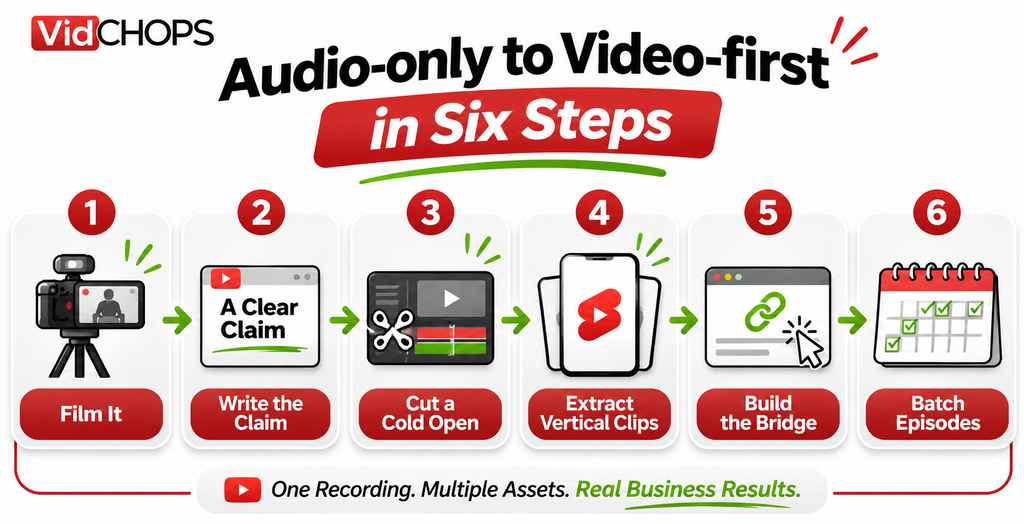
Step 1 — Film it. That’s it.
One camera at eye level, good audio (which you already have), a clean background. You do not need a studio. Augie films in a permanent corner setup because the setup is what kills consistency — not the filming.
Step 2 — Write the claim before you record
Decide the title and the thumbnail concept before the guest shows up. Brief them on the angle in the green room. Then capture two or three specific images during the shoot for the thumbnail: eye level, mid-expression, one with hands visible.
Step 3 — Cut a 30-second cold open
Take the sharpest exchange from anywhere in the hour and put it first. This is the single highest-leverage edit on a podcast video.
Step 4 — Extract, don’t repurpose blindly
A clip dump looks like a clip dump. Instead, pick the four to six moments that stand alone — a specific claim, a specific number, a specific story — and cut each one to be comprehensible with zero context. Vertical, captioned.
A VidChops note: this is the step almost everyone underestimates. We repurpose long-form into vertical shorts as part of every plan, and the difference between a clip that works and one that doesn’t is almost always whether it opens on a claim rather than a hello. Two free repurposed videos per edit are included.
Step 5 — Build the bridge
Website link at the top of every description, not buried. A free resource that solves the exact problem the episode discussed. An email list so you’re not dependent on an algorithm you don’t control.
Step 6 — Batch it
Record two or three episodes in one session. You’re already lit, already dressed, already in the headspace. The marginal cost of episode two is almost nothing.
The honest caveats
Audio isn’t dead. Plenty of people listen in cars and at the gym. Keep publishing audio — it’s free once you have the video. The point is you’re currently only publishing audio, not that you shouldn’t.
Video podcasts are harder to edit. More footage, more corrections, more framing to fix. The FAQ on our own site is honest about limits — finished videos over 20 minutes need more than the standard 1–2 day turnaround. Budget for it.
Not every podcast should be video. If your show is investigative audio with heavy production, or if your guests will only do audio, forcing video may hurt. But for a coach, consultant or business owner having conversations with experts, video is strictly additive.
And this won’t fix a show nobody wants. If the conversations aren’t interesting, video makes the problem more visible, not less. Distribution amplifies what exists.
Where VidChops fits
Our founder Augie built the company after burning out on his own channel — 300+ videos, 20 million views, then he quit. He’d been editing everything himself. The lesson wasn’t “work harder,” it was “the extraction is the business.”
The podcast pipeline is exactly what our model was built for:
- One recording → many assets. A credit is 1 long-form video or 4 short-form videos, mix and match. So a single podcast episode becomes the long-form upload plus your clip package.
- Repurposing included, not upsold. Vertical shorts with captions are part of every plan. Other agencies charge up to $999/month for it.
- 1–2 day turnaround, 1-day revisions, no contract.
- YT Helper takes the upload off your plate entirely — two thumbnails split-tested against each other, plus titles, tags, descriptions and scheduling.
- You keep the audio. Publish it to Spotify and Apple as usual.
That’s the “1 hour a week” promise on our YouTube landing page, and it’s not marketing fluff — it’s the arithmetic of removing post-production from your week.
If you want the deeper system, Augie’s breakdown of how to publish 40 videos a month in about three hours a week is in our free resources library, alongside a guide to getting the most out of working with your editor.
Book a call and bring your last three episodes. We’ll tell you honestly which ones had a clickable claim in them — and which ones didn’t.
FAQ
Do I need special equipment to make my podcast a video podcast?
No. A modern phone or mirrorless camera at eye level, decent lighting, and your existing microphone is enough. Audio quality matters more than camera quality — people forgive soft video, they don’t forgive bad sound.
How long should a video podcast episode be?
Long enough to be worth watching, and no longer. The data shows average video length is up 51% since 2020 and people are watching longer, so 40–70 minutes is entirely viable on YouTube now — especially on TV. But a padded 90-minute episode will underperform a tight 45.
Can I publish the same episode as audio and video?
Yes, and you should. Record video, publish the audio to podcast platforms, and publish the video to YouTube as a separate asset. Two distribution channels, one production cost.
How many clips should I cut from one episode?
Four to six that genuinely stand alone. Fewer, better clips beat a high-volume dump — a clip that needs the previous two minutes of context won’t travel.
Will a video podcast bring me clients faster than audio?
It can, because it’s discoverable by people who don’t know you yet, and video builds trust faster than audio. But it only converts if you have a clear next step — a link, a resource, a way to book. Discovery without a bridge just gets you views.
Do I need to be on camera? Am I going to hate watching myself?
You will hate watching yourself for about four episodes, and then you’ll stop noticing. Augie’s advice after 300+ videos: nobody is studying your face as hard as you are. The audience is listening to what you say.
Stop publishing in a container that can’t travel
You have the hardest part already done — the conversations, the expertise, the guest list. What you’re missing is the extraction.
Film it. Cut a cold open. Package a claim instead of an episode number. Publish to the platform where strangers can find you. Then do it again next week.
Eighty episodes of goodwill is sitting on a hard drive. It’s not a waste — it’s inventory.