How long should a YouTube video be in 2026? With more viewers watching YouTube on television and average long-form video lengths continuing to increase, the way people consume video content is changing. For business owners and creators, this shift creates a major opportunity to rethink their YouTube video length for business, embrace a long-form YouTube strategy, and create videos that build trust, demonstrate expertise, and attract potential customers. In this guide, we’ll explore the latest YouTube TV viewership trends, the ideal video lengths for different content formats, and how done-for-you video editing can help you produce high-quality, longer videos consistently without spending hours editing.
You learned YouTube the way everyone learned YouTube.
Keep it short. Cut every dead air moment. Change the visual every two seconds. Get to the point in eight minutes because nobody has an attention span anymore.
So you built your videos that way. Tight edits, rapid cuts, jump-cut after jump-cut. And it worked — for the phone in someone’s hand, in a hallway, at half attention, thumb hovering over the scroll.
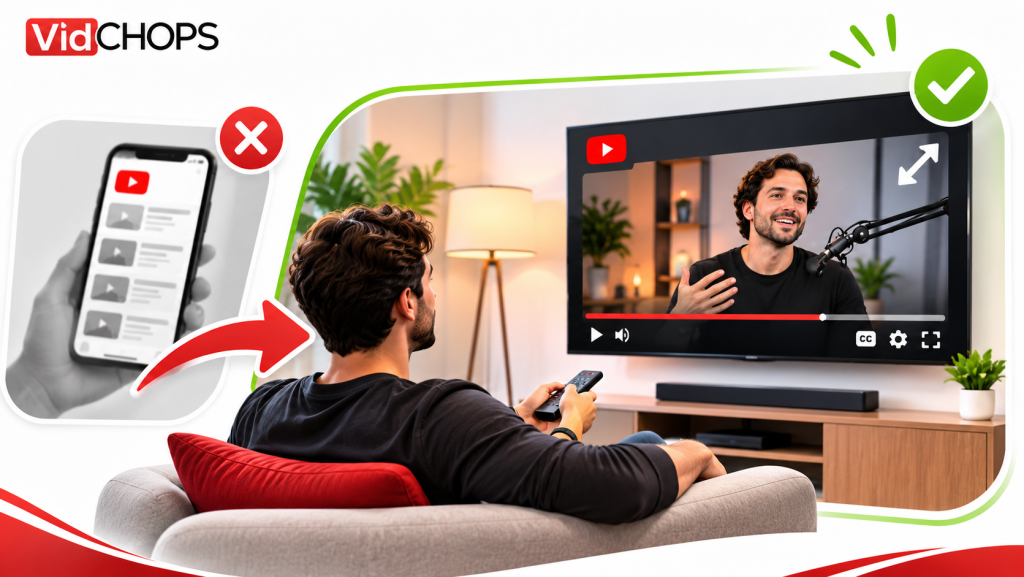
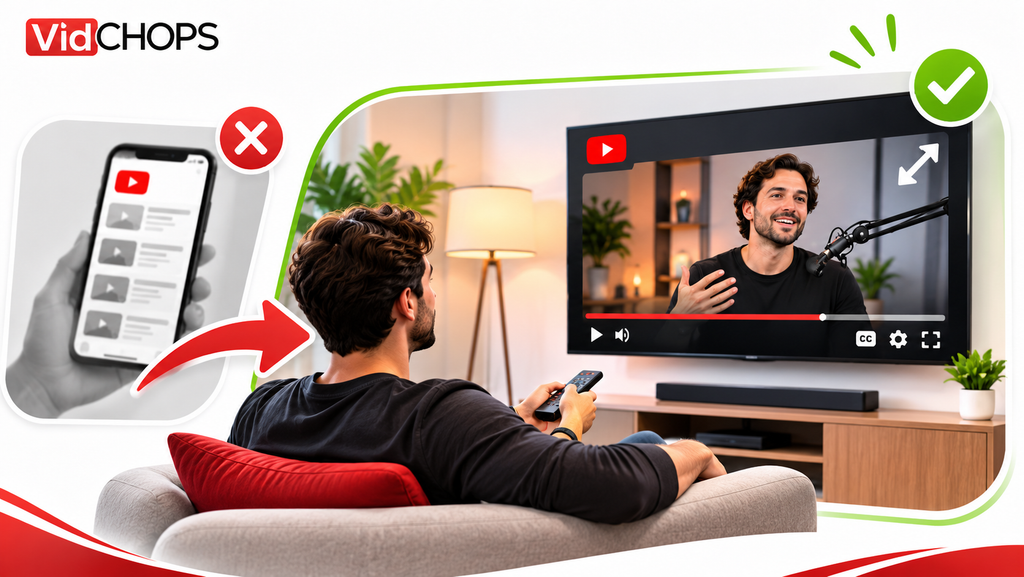
Here’s the problem: your viewer isn’t in the hallway anymore. They’re on the couch.
When someone sits down and turns on YouTube on a 55-inch TV, the rules inverts. They’re not looking for a dopamine hit before they swipe away. They’re looking for something worth settling into — the kind of thing they’d previously have gotten from Netflix or HBO. And when they see a 7-minute video built for a phone, it doesn’t read as efficient. It reads as disposable. They scroll past it.
That single behavioural shift — the move from phone to television — has quietly rewritten what works on YouTube. Most business channels haven’t caught up. That’s an opening for you, and it’s an expensive gap if you ignore it.
Watch: Why YouTube Just Became a TV Network for Creators
Why YouTube Just Became a TV Network for Creators
The Numbers Behind the Shift
This isn’t a hunch. Three data trends have all moved in the same direction at once.
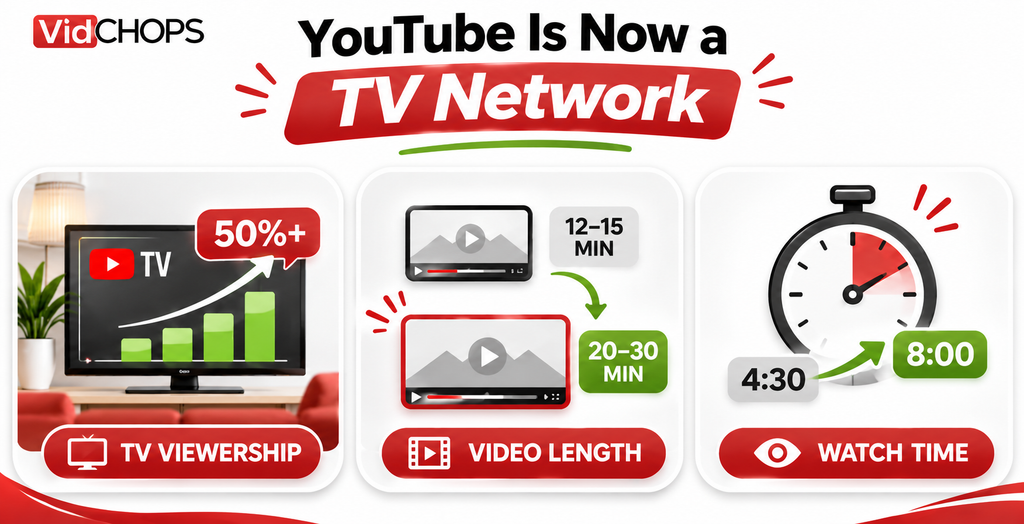
1. TV is now the majority device. For large channels, connected-TV viewership has gone from roughly a quarter of all watch time in 2021 to more than half today. On many channels it’s now the single biggest device category by a wide margin.
2. Videos got longer — a lot longer. Average long-form video length has risen about 51% since 2020. Where creators were shipping 12–15 minute videos, the norm is now 20 minutes plus, and 30+ minute videos are common on channels that would have never attempted them three years ago.
3. People watch for longer. Average view duration on long-form has climbed sharply over the same period — in tracked channel datasets, roughly from around four and a half minutes toward eight minutes. Nearly double in four years, while attention spans were supposedly collapsing.
Those three things reinforce each other. Longer videos are watchable on TV. TV viewing rewards longer videos. And because YouTube reflects what its audience actually does, the platform surfaces more of what people stay with.
Meanwhile, the fast-cut “retention editing” style that dominated 2020–2023 is losing its edge. One of the highest-performing brand videos of the last year was a 31-minute, barely-edited skiing documentary with no narration — 30 million-plus views. Five years ago that video would have been cut to 10 minutes and ruined.
The takeaway: the format you learned three years ago is now the format working against you.
Why This Matters Specifically for Business Owners
If you’re running a company channel, this shift is more consequential for you than for entertainers. Here’s why.
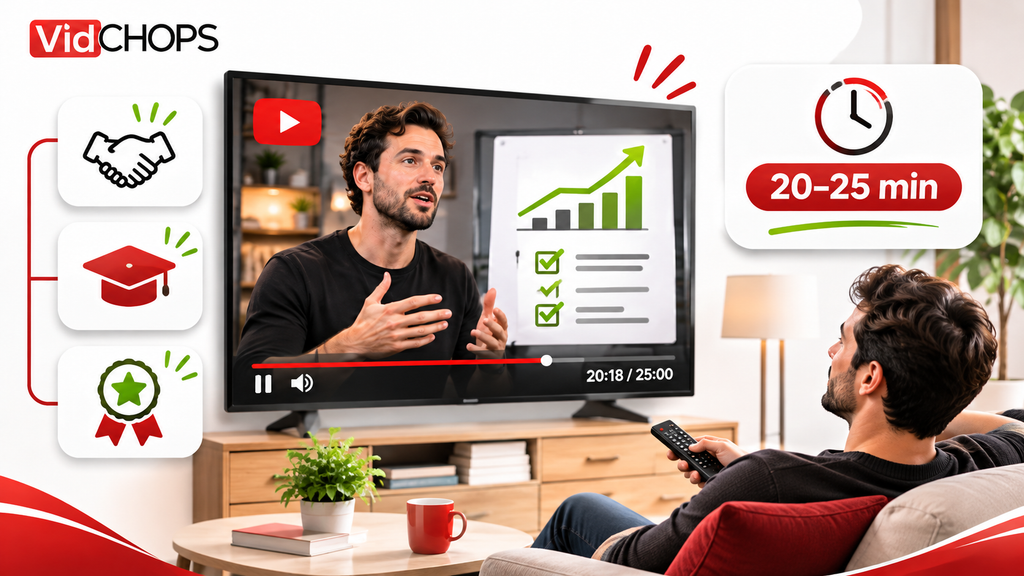
Trust is built in minutes, not seconds. A prospect who watches 20 minutes of you explaining your industry has effectively attended a seminar. They arrive on a sales call already convinced. A 6-minute clip doesn’t do that — it demonstrates competence but doesn’t build relationship.
Your subject matter needs room. Explaining a real business problem properly — the context, the nuance, the exception cases — takes time. Compressing it into 7 minutes either makes you sound shallow or forces you to skip the parts that actually prove your expertise.
TV viewing is lean-back, co-viewing behaviour. More and more, people watch longer YouTube content with someone else in the room — a partner, a colleague, a client. That’s a fundamentally different consumption mode than solo phone scrolling, and it’s far more likely to result in a conversation about your brand.
Longer videos keep earning. A 30-minute video that a viewer finishes generates more total watch time per session than three shorter ones they abandon. YouTube rewards session time, so the compounding effect is real.
How Long Should Your Videos Be in 2026?
There’s no universal number, but there are practical ranges that hold up across business channels right now:
| Video type | Recommended length | Why |
| Deep tutorial / teaching video | 15–25 minutes | Room to teach properly; matches TV viewing preference |
| Case study / breakdown | 20–35 minutes | The story carries the length; viewers stay for the resolution |
| Podcast / interview | 30–90 minutes | Conversation format; naturally long-form |
| Brand documentary / flagship | 20–45 minutes | High production value earns the runtime |
| Quick answer / FAQ | 3–8 minutes | Still valid — but volume, not depth |
| Short-form clips | 30–90 seconds | Discovery layer only; drives to the long video |
The important thing isn’t hitting a target number. It’s this: if a video deserves to be 24 minutes, make it 24 minutes. The instinct to cut it down for retention is now often the wrong instinct.
The one rule that still applies
Length is never permission to pad. A 25-minute video that rambles loses harder than an 8-minute video that’s tight. The pendulum hasn’t swung to “long is always better” — it’s swung to “long is viable again, if it’s earned.”
The first 15–30 seconds still matter enormously. You still need to confirm the click immediately, deliver on the thumbnail’s promise, and give a reason to keep watching. What’s changed is what happens after that: you can now let a scene breathe instead of cutting every 1.5 seconds.
The Three Production Problems Longer Videos Create
Here’s where business owners run into trouble. Longer videos are better for your channel — and harder to produce. Three specific ways:
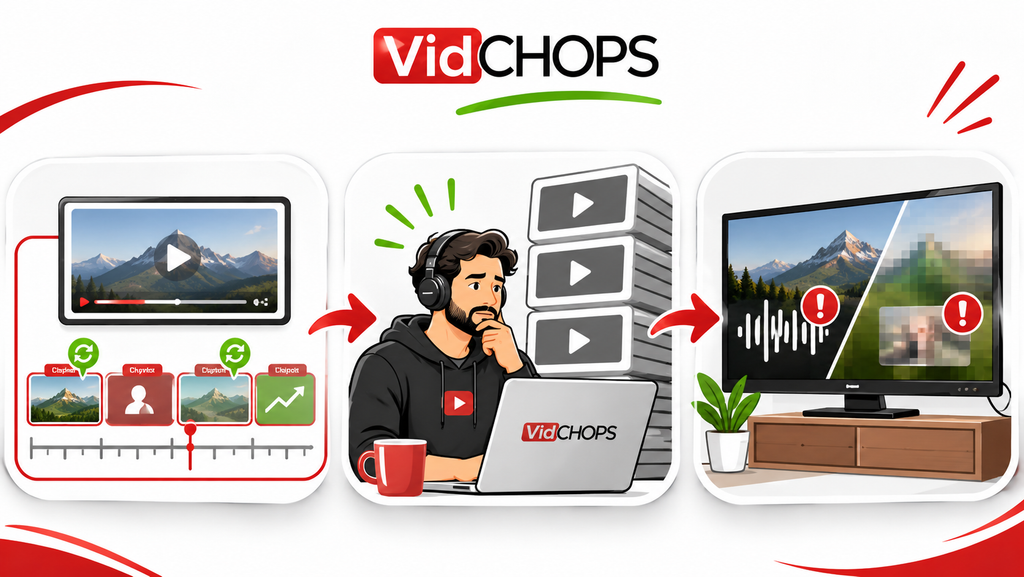
1. Pacing becomes harder, not easier. A tight 8-minute video is forgiving: cut fast, keep moving, done. A 25-minute video needs actual structure — chapters, re-hooks, visual variety, deliberate changes in energy. Without that, viewers leave at minute 12 and never come back.
2. The edit time roughly triples. More footage, more cuts, more colour correction, more B-roll, more graphics. If a 10-minute video was 5 hours of editing, a 25-minute video is 12 or more. That’s a full working day per video, per week.
3. The production bar rises on TV. Compression artefacts, bad audio, blown-out backgrounds, a phone mic — these all look worse on a large screen. TV audiences are less forgiving of amateur production because they’re comparing you to Netflix, not to other YouTubers.
You can solve all three by learning to edit at a high level. Or you can solve them by not editing at all.
The Practical Fix: Keep the Format, Drop the Editing
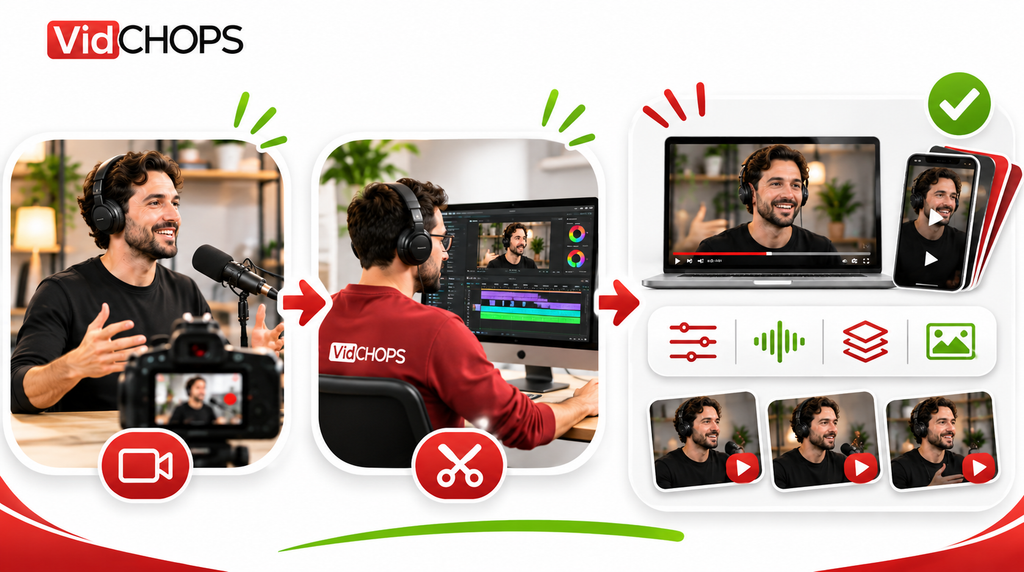
The strategic decision — go longer, structure better, raise production quality — is the easy part. Executing it weekly, on top of running a business, is where channels die.
That’s the specific problem VidChops exists to solve. You film. We handle everything after:
- Editing built for watch time — pacing, structure, chaptering, and B-roll that holds a viewer for 25 minutes rather than 8
- Broadcast-grade polish — colour grading, audio cleanup, lower thirds, text animation, motion graphics
- Thumbnails with A/B split testing — two designs per video, tested against each other, via YT Helper
- Titles, tags and descriptions written for click-through, not just keywords
- Uploading and scheduling so the video goes live on time, every time
- Repurposing into vertical shorts at no extra cost, so the long video also feeds Shorts, Reels and TikTok
- 1–2 day turnaround, unlimited revisions, 14-day money-back guarantee
Flat-rate subscription, no contract. You can see examples of our work here, or start the 7-day free trial and get all of your YouTube content done in one hour a week.
What to Do This Week
If you want to capitalise on the TV shift before your competitors notice it, three concrete moves:
- Audit your last five videos’ device breakdown. Check the “Device type” report in YouTube Studio. If TV is above 30% for you, you’re already in this new world and your format needs to match it.
- Pick one topic that deserves 20 minutes. Not all of them. One. Something where your buyer genuinely needs the full explanation — a case study, a process breakdown, a myth you want to dismantle properly.
- Stop cutting it down to fit an outdated rule. Structure it well, shoot it clean, and let it run as long as the idea needs.
Then get the edit off your plate, because this only compounds if you can sustain it weekly.
Frequently Asked Questions
Is it true that most YouTube viewing now happens on TVs?
For many large channels, yes — connected TVs have become the single largest device category, passing 50% of watch time in several cases. Mobile still dominates for short-form and for discovery, but long-form viewing has shifted decisively toward the living room.
Does this mean short videos no longer work?
They still work, especially for search-driven “quick answer” content and for Shorts. What’s changed is that short is no longer automatically better. A channel making only 6-minute videos is now leaving significant watch time on the table.
How long should a YouTube video be for a business channel?
Generally 15–25 minutes for teaching videos, 20–35 for case studies, and longer for podcasts and flagship documentaries. The right length is the shortest version that fully delivers on the title’s promise — not the shortest version possible.
Won’t a longer video hurt my retention percentage?
Your average percentage viewed will likely drop, and that’s expected and fine. What matters is total watch time and satisfaction. A 25-minute video at 35% retention produces more watch time than an 8-minute video at 60%.
Does production quality really matter more now?
Yes, because TV viewers are comparing you to streaming services rather than to other YouTubers. Audio quality especially — a bad mic is far more noticeable through TV speakers or a soundbar.
Can VidChops handle longer videos like 30-minute podcasts?
Yes. Standard turnaround is 1–2 days for videos up to around 20 minutes; longer or more complex edits, including video podcasts, are handled with a bit more time and we’ll confirm the schedule upfront.
What if I already have older, shorter videos?
Don’t delete them. Update the thumbnails and titles and let them keep working, then shift your forward-looking format to match how people watch now.
Ready to Make Videos Built for the Living Room?
The shift already happened. Nobody announced it, and most business channels haven’t adjusted — which means the ones that do, right now, get an outsized advantage while the format is still wide open.
But longer videos, structured better, produced to a higher standard, are not something you can squeeze into a Sunday evening. That’s the whole reason we exist.
→ Book a call with VidChops and we’ll map out your 2026 video format on a 15-minute call. Bring your channel and your three best videos — we’ll tell you exactly which ones to make longer and how.
→ Start your 7-day free trial — all of your YouTube content done in one hour a week.
→ See how YT Helper handles thumbnails, titles and uploads so you never touch the backend again.
→ Browse our portfolio to see long-form edits we’ve produced for business channels.
→ Grab our free YouTube resources — including the 75 YouTube Video Ideas guide, free.
→ Running an agency? See our white label editing service and offer long-form production without hiring editors.