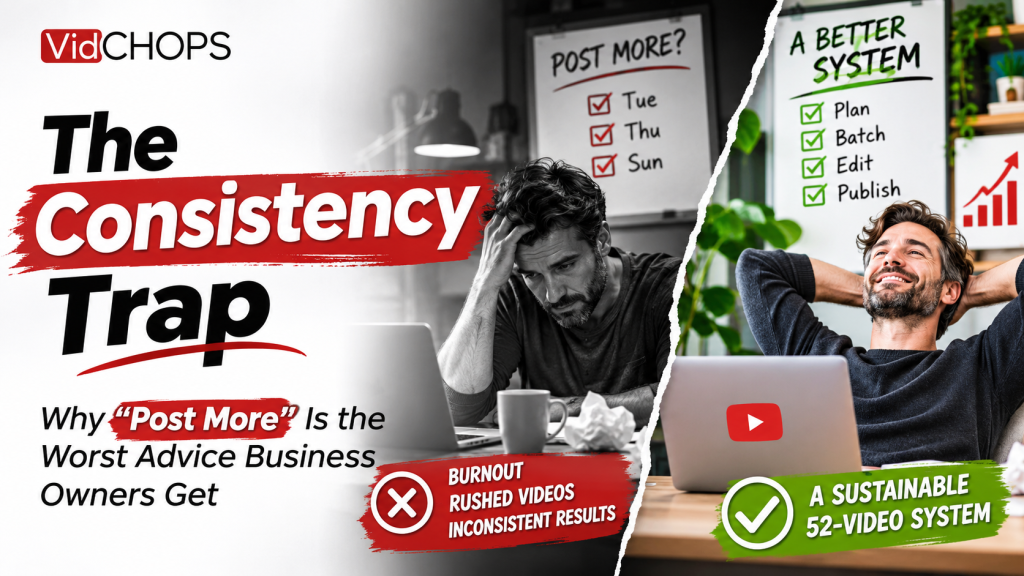
How often should you post on YouTube as a business owner? If you’ve been told that posting more frequently is the secret to growing your channel, it’s time to rethink that advice. Constantly filming, editing, and uploading videos can quickly lead to content creation burnout, especially when you’re already running a business. The truth is that YouTube consistency isn’t about publishing as much as possible; it’s about building a sustainable system that prioritizes quality, strategic content, and long-term growth. In this article, we’ll explore why upload frequency isn’t necessarily the key to success and how a simple 52-video-per-year strategy can help you grow your channel without sacrificing your time, energy, or business.
The advice that’s quietly wrecking your channel
There’s a piece of advice that gets repeated in every YouTube growth video, every creator newsletter, every comment section on the internet. It goes like this: be consistent. Post more. The algorithm rewards volume.
It sounds like discipline. It sounds like the thing successful people do. So you try it. You post twice a week for six weeks. You’re editing at 11pm. You’re filming on a Sunday when you should be with your kids. Your videos get slightly worse each time because you’re rushing them, and your views go sideways, and then one week you miss a Tuesday, and then you miss a Thursday, and then it’s been three months and your channel is a graveyard with a half-finished “I’m back!” video sitting in a folder.
And here’s the part nobody tells you: the volume was never the point. You didn’t fail at consistency. You were sold a strategy that was designed for someone with a completely different life than yours.
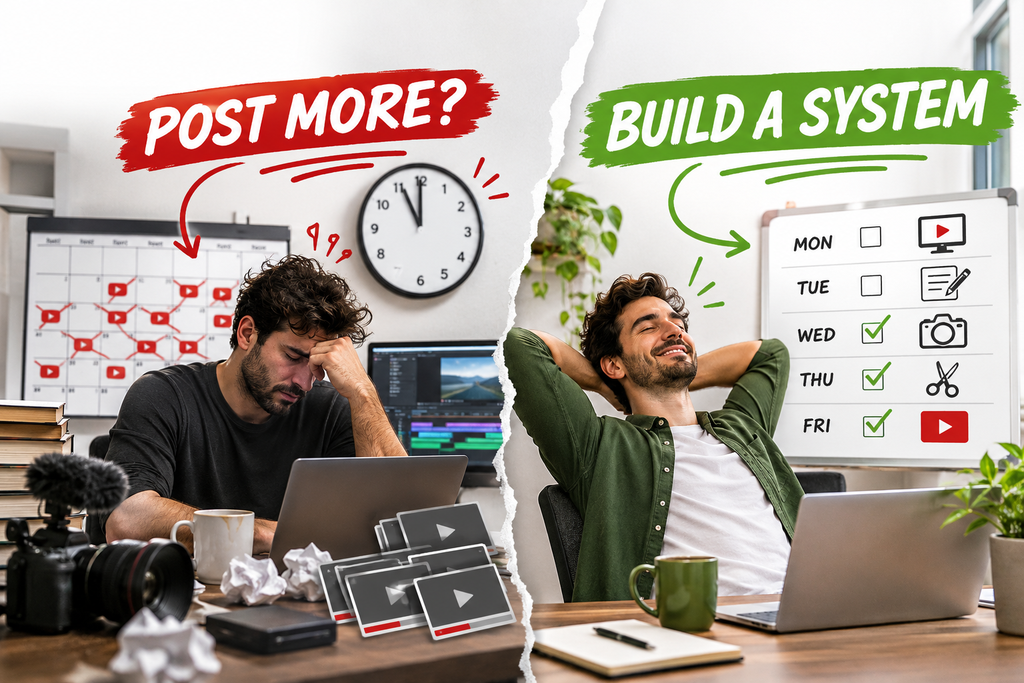
Let me show you what the data actually says.
What the research says about posting frequency
In the Patty Galloway episode on the Open Residency podcast (published September 2026), he cites a VidIQ study on upload frequency and subscriber growth. The finding, as he describes it, is brutal:
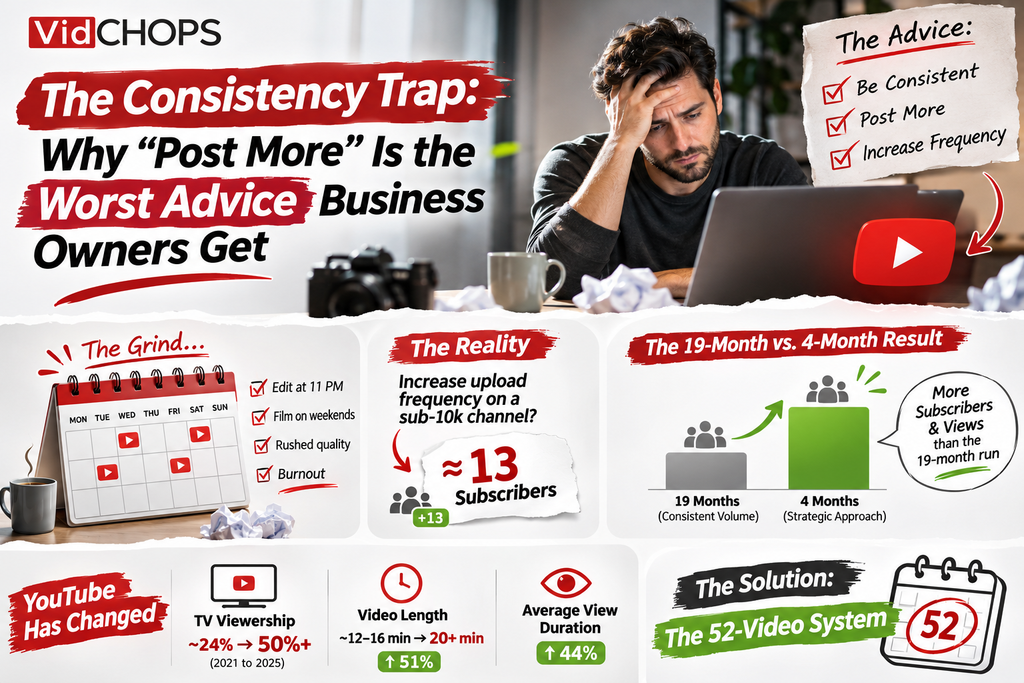
“Less than 10,000 subscribers. And if you increase the frequency at which you upload, you gain like 13 subscribers. 13 subscribers. I still can’t believe it.”
Read that again. For a channel under 10,000 subscribers, increasing your upload frequency — the single piece of advice you hear most often — moves the needle by roughly 13 subscribers.
Now compare that to what Galloway says about his own experience. He spent 19 months posting consistently and “it never happened.” Then, in a 4-month period using a different approach, he got more views and more subscribers than he did across those entire 19 months.
Nineteen months of consistency. Beaten by four months of doing something different.
That’s the trap in one sentence: consistency is a multiplier, not a strategy. If you multiply a bad approach by 19 months, you get 19 months of bad results. If you multiply a good approach by four months, you get a channel.
The chart that should end this argument
Here’s the comparison, laid out plainly. This is the chart I’d build for the post:
Chart 1: “Effort vs. Outcome — Two Approaches to the Same 19 Months”
| Approach | Duration | Subscribers gained | Views gained |
| Consistent volume, no packaging strategy | 19 months | Baseline | Baseline |
| Strategic ideation + packaging, 2 videos/week | 4 months | More than the 19-month run | More than the 19-month run |
Source: Patty Galloway, Open Residency podcast, September 2026. Self-reported; treat as a case study, not a controlled experiment.
Chart 2: “What Increasing Upload Frequency Actually Gets You (Sub-10k Channels)”
A single-bar chart. One bar, labelled “Subscribers gained from increasing upload frequency,” value: ~13.
That second chart is the whole argument. One bar. Thirteen subscribers. That’s what you’re trading your Sundays for.
Why “post more” advice exists at all
Before I go further, let me be fair to the people giving this advice, because it’s not malicious. It’s just outdated.
The “post more” era made sense when YouTube was a different platform. Shorter videos, mobile-first viewing, a recommendation system that rewarded recency and volume. In that world, more uploads meant more lottery tickets, and more lottery tickets meant more chances to hit.
That world is gone. Here’s what replaced it.
Viewing has moved to the TV. In the same podcast, Galloway presents client data showing TV viewership going from roughly 23–24% in 2021 to over 50% by 2025. When someone’s watching on a 55-inch screen in their living room, they’re not looking for a quick hit. They’re settling in. They’re choosing you over Netflix.
Videos have gotten longer. Across 100 billion views of data, the average long-form video length is up 51% since 2020 — from roughly 12–16 minutes to 20+ minutes.
And people are watching longer. Average view duration across Galloway’s clients and accelerator students is up 77% in four years, from 4:35 to 8:00.
Put those three facts together and the implication is obvious. The platform now rewards depth, not frequency. A 25-minute video that holds someone for 12 minutes beats four 8-minute videos that hold nobody. And you cannot make a 25-minute video that holds someone for 12 minutes when you’re filming it on a Tuesday night because the calendar said so.
The real problem: you don’t have a consistency problem, you have a system problem
Here’s the reframe that changes everything.
When business owners tell me they can’t stay consistent, they almost always think the problem is willpower. They think they need more discipline. So they buy a planner, they set a 5am alarm, they whiteboard a content calendar, and they fail again — and now they feel worse, because they’ve proved to themselves that they’re the problem.
They’re not the problem. The process is the problem.
If your content process requires you to be motivated, then your content will stop the moment you’re not motivated. And you will not be motivated. You’re running a business. You have clients, staff, cash flow, a family, and a hundred things that are more urgent than filming a video that might get 400 views.
The business owners who actually stay consistent aren’t more disciplined than you. They’ve just removed the friction. They’ve built a system where the video gets made whether they feel like it or not.
Here’s what that system looks like.
The 52-video system (and why it beats 200 rushed ones)
One high-quality video per week. That’s it. That’s the whole commitment.
52 videos a year. Do that for two years and you have over 100 videos on your channel.
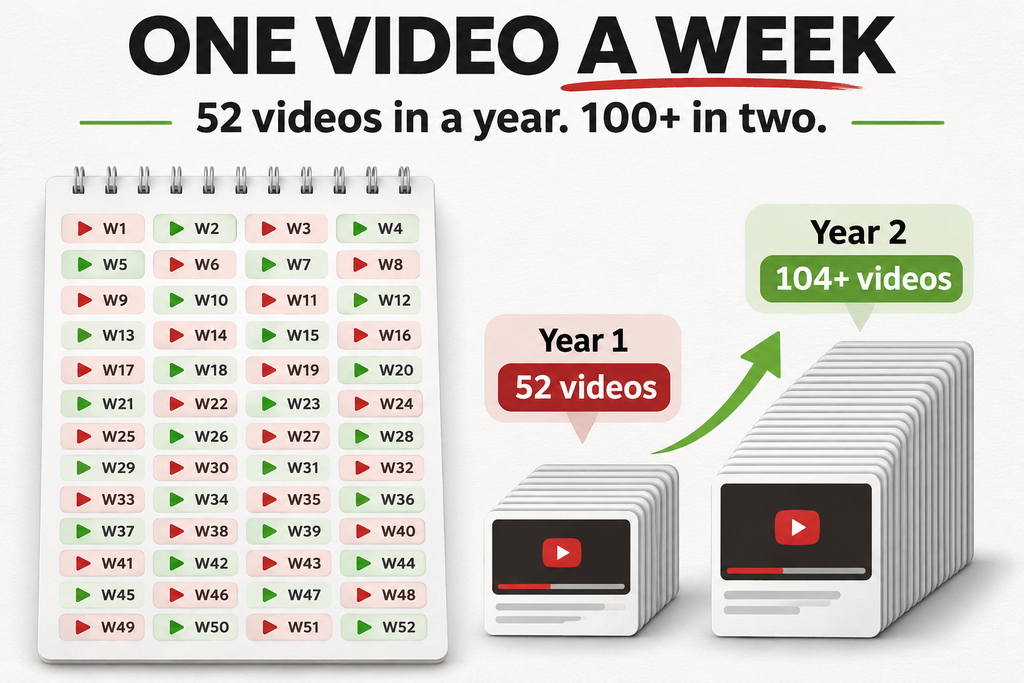
That’s 100 separate chances to be discovered. 100 opportunities to answer a customer’s question. 100 pieces of proof that you know what you’re talking about.
And here’s the compounding part that most people miss: you only have to answer each question once. The video about “how do I know if I need a bookkeeper” keeps answering that question for years. You filmed it in March 2026 and it’s still working in 2029.
Compare that to the volume approach. 200 rushed videos where 180 of them are forgettable, and the 20 good ones are buried under the noise of your own channel. You didn’t build an asset library. You built a landfill.
The four pillars that kill the blank page
The single biggest friction point is sitting down to film and not knowing what to say. Fix that with three to five content pillars — the recurring categories you’ll always have something to say about.
If you’re a business owner, those might be: lead generation, sales, marketing, hiring, systems. If you’re a coach: client acquisition, pricing, mindset, delivery. If you’re a consultant: the specific problems you solve, the mistakes you see, the objections you hear, the results you get.
Then, instead of staring at a blank page, you rotate through the pillars and apply a prompt to each one:
- What mistakes do people make with [pillar]?
- What myths exist about [pillar]?
- What framework do I use for [pillar]?
- What’s a story about [pillar] that taught me something?
- What objections do people have about [pillar]?
Five pillars × five prompts = 25 video ideas, generated in about ten minutes. That’s six months of content from one sitting.
The permanent filming setup
This is the one that saves the most time and the one almost everyone gets wrong.
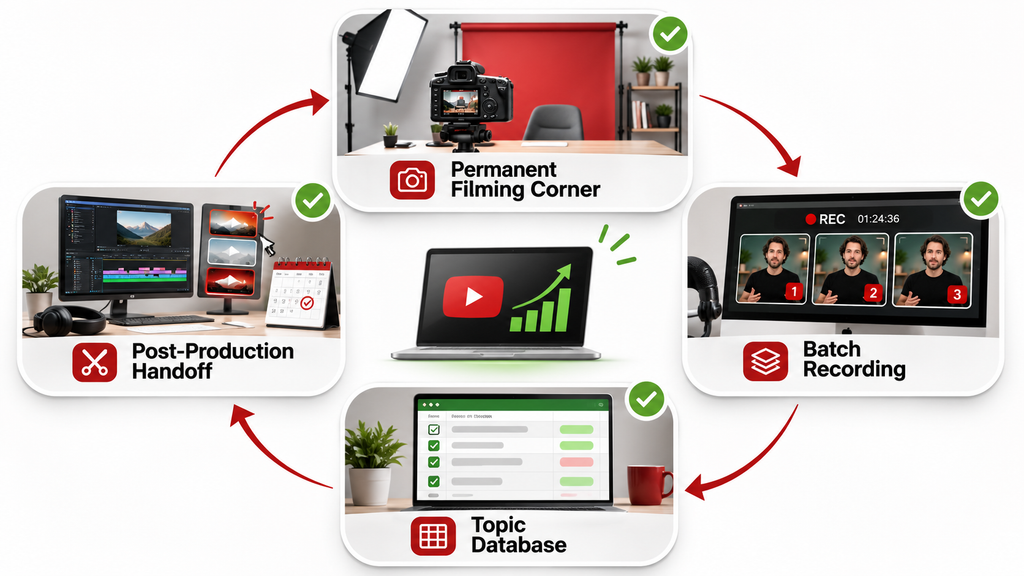
Most business owners set up their camera, lights, and background, film one video, then tear the whole thing down. Next time they need to film, they do it all again. That setup-and-teardown cycle is what kills consistency — not the filming.
Find one corner of your house or office where the camera, lights, and background can stay up permanently. You never take it down. You walk over, hit record, and you’re filming in four seconds.
And when you do film, batch it.
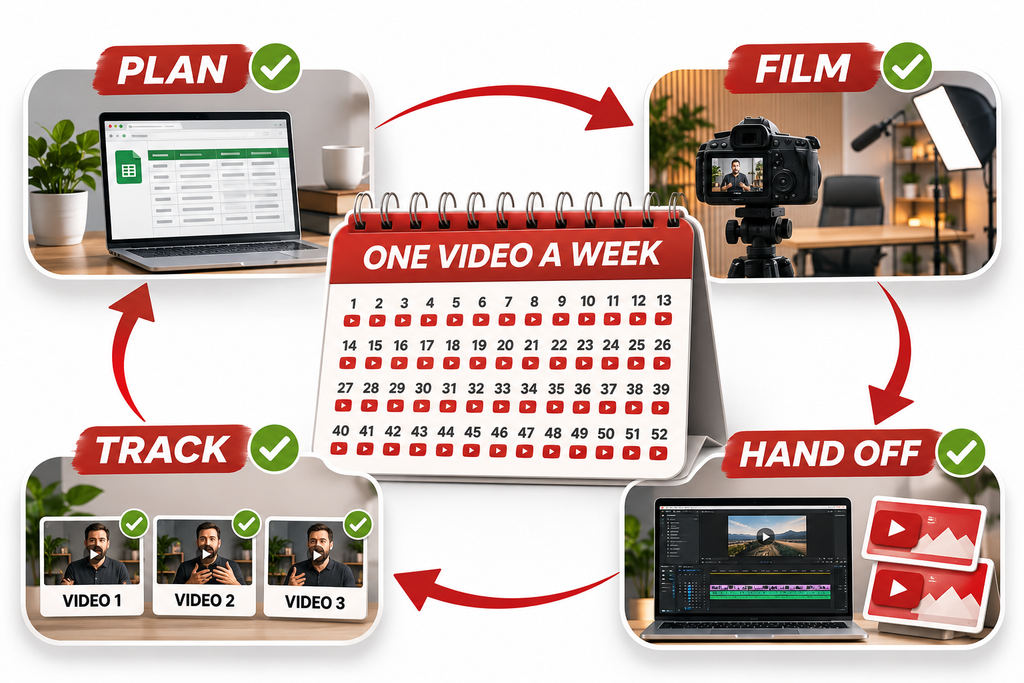
Two or three videos in one session, not one. You’re already lit, already dressed, already in the headspace. The marginal cost of video two and three is almost nothing.
The topic database
Keep a running Google Sheet with a column per pillar. Every time a client asks you a question, every time you have an insight in the shower, every time you see a competitor’s video that made you think “I’d say that differently” — it goes in the sheet.
When it’s time to film, you don’t brainstorm. You open the sheet and pick.
The part you hand off
Here’s the honest bit. Even with all of the above, there’s still editing, thumbnails, titles, tags, descriptions, uploading, scheduling, and split-testing. For most business owners, that’s where the system collapses — not at the filming stage, at the post-production stage.
That’s the specific problem VidChops exists to solve. You film and send us the footage. We handle the edit, design and split-test the thumbnails, write the titles, tags and descriptions, and upload and schedule it. Turnaround is 1–2 days, revisions in 1 day, and repurposing into shorts is included.
The point isn’t that you can’t learn to edit. The point is that you shouldn’t have to, because every hour you spend in Premiere Pro is an hour you’re not spending on the work that actually pays you.
The honest caveats
I’d be doing the same thing I’m criticising if I pretended this was universal. So:
This doesn’t apply if you’re a full-time creator chasing ad revenue. If your business model is views and AdSense, volume genuinely does matter more, because you’re monetising attention directly. Different game, different rules.
This doesn’t apply if you’re in a fast-moving news niche. If your content is about what happened yesterday, you have to be there yesterday. But if you’re a business owner teaching what you know, almost nothing you say expires in a week.
One video a week is a floor, not a ceiling. If you can do two, do two. Galloway’s own recommendation is around two per week, because it gives you enough shots to test different titles and thumbnails. But two is not the same as daily, and daily is not the same as good.
And the uncomfortable one: if your videos are genuinely bad, posting more of them won’t help. Consistency amplifies whatever you already have. If what you have is a packaging problem, a hook problem, or an idea problem, more volume just means more people ignoring you. Fix the thing first, then scale it.
What to do this week
Not next month. This week.
- Pick your three to five pillars. Write them down. Ten minutes.
- Generate 25 ideas using the five prompts against each pillar. Twenty minutes.
- Find your permanent filming spot. Move a lamp. Clear a wall. Make it so the camera never has to move again. One hour.
- Film two videos in one sitting. Not one. Two. Use the first idea from your list.
- Send the footage to someone else. A freelancer, an editor, or us. The moment you stop being the bottleneck on post-production is the moment consistency stops being a willpower problem.
Then do it again next week. And the week after. Not because the algorithm demands it, but because 52 videos from now you’ll have something you don’t have today: a library of proof that you’re the person who knows what they’re talking about.
That’s the actual goal. Not consistency for its own sake. Consistency as the byproduct of a system that doesn’t depend on how you feel on a Tuesday.
FAQ
How often should I post on YouTube as a business owner?
Once a week, minimum. Twice a week if you can sustain it without the quality dropping. Daily posting is designed for full-time creators monetising views directly — it’s the wrong model for someone using YouTube to generate clients.
Is it bad to post inconsistently?
Inconsistency itself isn’t punished by the algorithm. What hurts you is that inconsistent posting usually means rushed videos, which means worse packaging and worse retention, which means the algorithm has less reason to promote you. The problem is the quality, not the gap.
What if I miss a week?
Nothing happens. Post the next one. The compounding effect of 52 videos a year doesn’t break because you did 51. What breaks it is quitting entirely because you missed one and decided you’d failed.
Do I need to post shorts too?
Shorts are useful for discovery but they’re a different audience with different intent. If you’re time-constrained, put your energy into long-form first — that’s where trust and clients come from. If you already have long-form footage, repurposing it into shorts is nearly free, and VidChops includes it in every plan.
How long should each video be?
Long enough to answer the question properly, and no longer. The data shows average video length is up 51% since 2020 and average view duration is up 77%, so there’s clearly appetite for longer content — but padding a 10-minute idea to 25 minutes will hurt you more than a tight 10-minute video ever would.
What if I don’t have time to film at all?
Then the problem isn’t consistency, it’s capacity. That’s a different conversation — and it’s the one we have on the call. Sometimes the answer is a podcast format, which is easier to produce and generates clips automatically. Sometimes it’s batching a month of content in one day.
The bottom line
“Post more” is advice that assumes your problem is effort. For almost every business owner I’ve worked with, the problem is friction — a process that requires motivation, a setup that takes twenty minutes, and a post-production workload that eats the weekend.
Fix the friction and consistency takes care of itself. Keep chasing volume and you’ll get exactly what the data says you’ll get: thirteen subscribers and a burnout story.
If you want to see what the back half of this system looks like when someone else runs it, book a call with VidChops — we’ll look at your channel, tell you honestly whether the bottleneck is volume, packaging, or production, and show you what a 52-video year would actually look like. If we’re not the right fit, we’ll tell you that too.