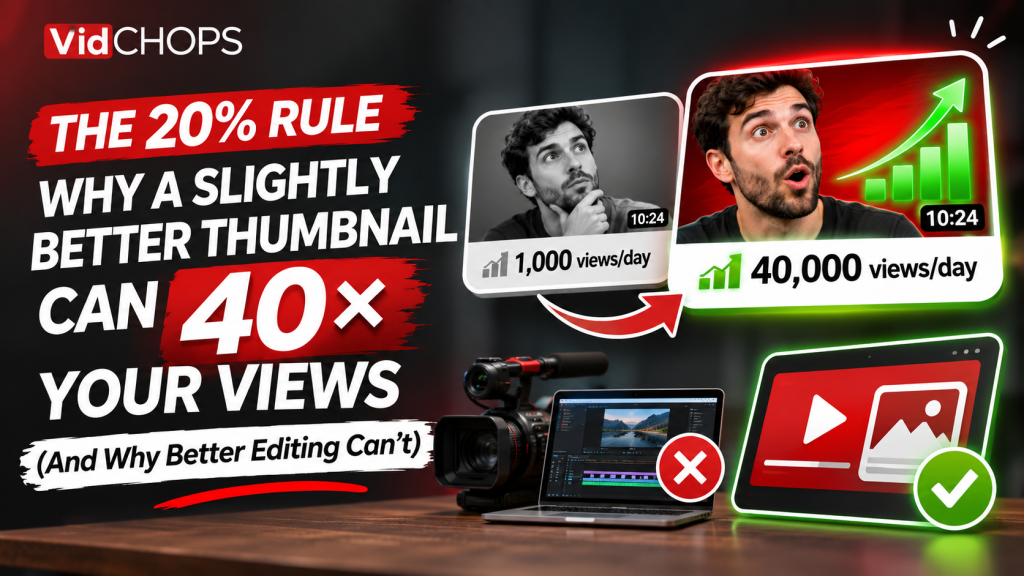
Most YouTube creators believe the secret to getting more views is better editing, professional transitions, and high-quality production. But what if they’re investing their time and money in the wrong place? The truth is, your YouTube thumbnail click-through rate can have a much bigger impact on your video’s performance than another few hours spent editing. A slightly better thumbnail can attract more clicks, generate more views, and give YouTube more reasons to recommend your content. So, if you’ve ever wondered why your YouTube videos get no views despite spending hours perfecting them, the problem might not be your editing. It might be your YouTube packaging.
The video that got 40 times more views without being re-edited
A web designer had a video sitting on his channel doing about 1,000 views a day. Decent thumbnail. Reasonable video. Nothing wrong with it.
His team sat down, brainstormed a new thumbnail concept, and he changed it. Not the video. Not the edit. Not the title. Just the thumbnail.
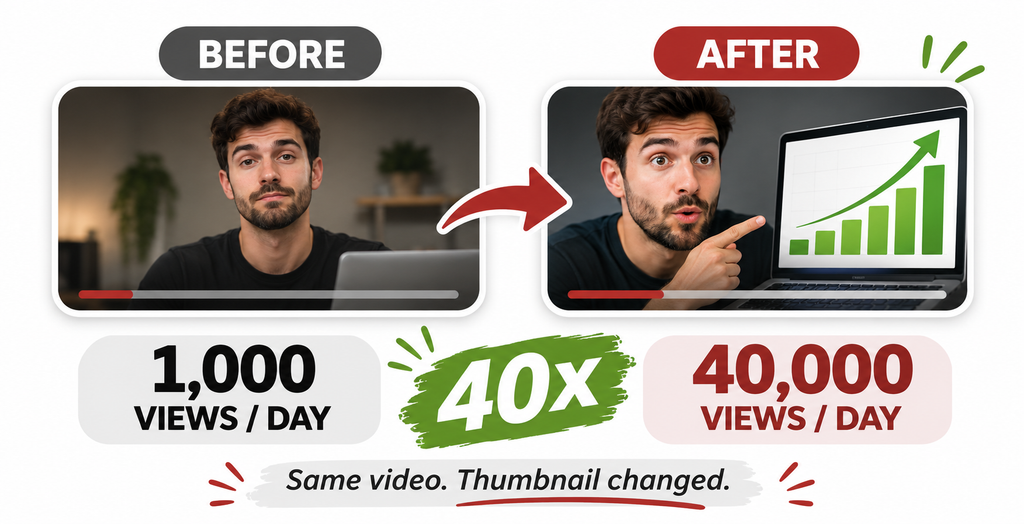
Within a day, that video went from 1,000 views a day to 40,000 views a day.
Forty times the views. From one image.
And here’s the part that should genuinely annoy you: if you’d put those two thumbnails side by side and asked strangers on the street which was better, most would say the new one was a bit better. Maybe 20% better. Maybe 30%. Nobody would say “forty times better.”
That gap — between a 20% improvement and a 40x outcome — is the single most important thing to understand about YouTube. And it’s the reason most business owners spend their money in exactly the wrong place.
Why a small improvement produces an enormous result
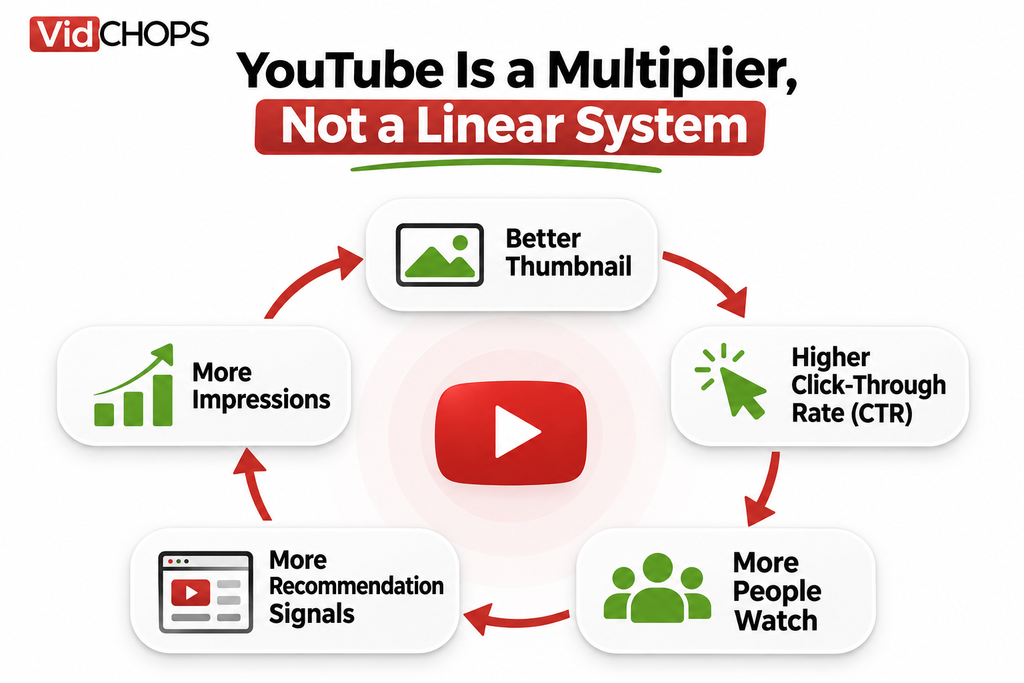
YouTube is not a linear system. It’s a multiplier.
If you make a video 10% better and get 10% more views, you’re thinking about it like a shop. More foot traffic, more sales, proportional. That’s not how this works.
Here’s the actual mechanism. A thumbnail that gets a 4% click-through rate versus one that gets 5% doesn’t just get 25% more clicks. It gets more clicks, which means more people watching, which means YouTube’s system has more data suggesting this video satisfies people, which means it gets pushed into a wider set of recommendations, which means more impressions, which means more clicks at that better rate, which compounds again.
Galloway’s framing of this is the cleanest version I’ve heard:
“Algorithms are multipliers… if something is a little bit better, it might be enough better to then reach so much of a wider audience because of how broad and exponential YouTube’s algorithm is.”
He compares it to professional sport. The player who makes the NBA isn’t five times better than the player who ends up semi-pro in Thailand. They’re maybe 10–20% better — a little faster, a little stronger, a little more consistent. But they’re playing in a system with nonlinear returns, so 15% better translates into a hundred times the income.
YouTube works the same way. You are not competing on a linear scale. You’re competing on a scale where small edges get amplified into enormous gaps.
The chart that reframes your entire budget
Here’s the comparison I’d build for this post.
Chart 1: “Same Video, One Change”
| Metric | Before thumbnail change | After thumbnail change | Change |
| Views per day | 1,000 | 40,000 | 40x |
| Video re-edited? | No | No | — |
| Title changed? | No | No | — |
| Perceived thumbnail improvement | — | ~20–30% | — |
Source: Patty Galloway, Open Residency podcast, September 2026. Self-reported student case study.
Chart 2: “Where Creators Spend vs. Where Returns Are”
A two-bar comparison per category, showing typical time allocation against typical impact on views.
| Stage | Typical % of creator time | Approximate impact on views |
| Idea | 10% | Highest |
| Title + thumbnail (packaging) | 5% | Very high |
| Filming | 25% | Moderate |
| Editing | 50% | Low–moderate |
| Upload / admin | 10% | Low |
Source: VidChops analysis based on Galloway’s “packaging is 50% of the game” framework and his recommendation that 10–20% of total production time go to packaging. This is an analytical model, not a measured study — label it as such.
Look at that second chart honestly. The place where most creators spend half their time is the place with the least leverage. And the place with the most leverage — the two seconds before someone decides to click — gets about five percent.
That’s the 20% rule. A 20% improvement in packaging beats a 20% improvement in editing, every single time, because packaging is upstream of everything.
The honest case for editing (and why it still loses)
I run a video editing company. So let me be the last person to tell you editing doesn’t matter.
Editing matters enormously — after the click. Once someone is watching, the edit is what determines whether they stay. Pacing, retention, b-roll, sound design, the cut that removes the four seconds where you said “um” and looked at your notes. All of it is real, and all of it affects watch time, which affects whether YouTube shows the video to more people.
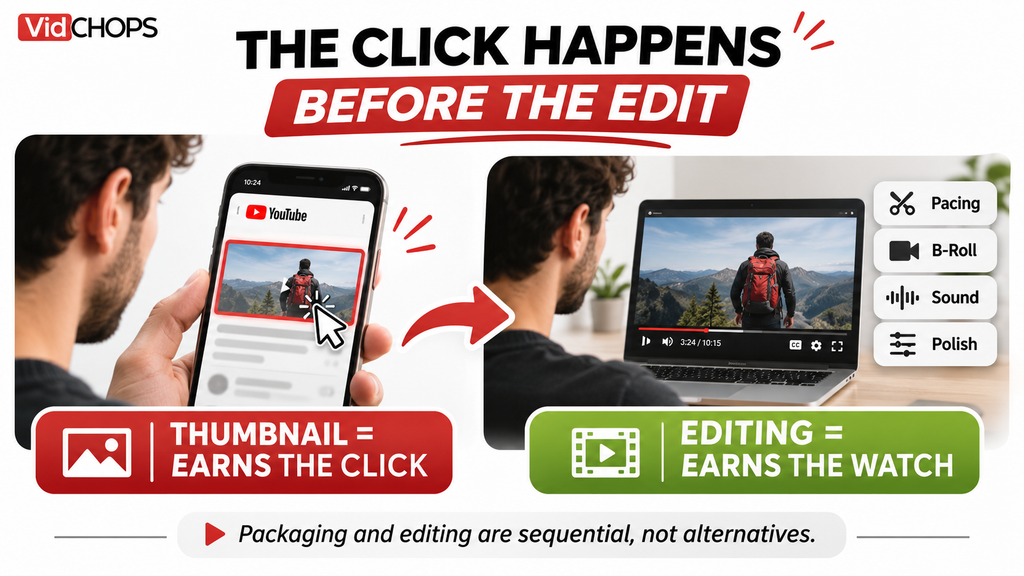
But here’s the brutal arithmetic. Editing cannot fix a video nobody clicks on.
If your thumbnail gets a 2% click-through rate, you can have the greatest edit in the history of the platform and almost nobody will ever see it. You’ve spent forty hours polishing something that four people per hundred will experience. The edit is a multiplier on a number that’s already close to zero.
Galloway puts the split bluntly: “the click part of the equation is kind of 50% of the game.” And he’s not saying editing is the other 50% — he’s saying the click is half of everything, and the rest is retention and satisfaction combined.
There’s a second reason editing loses this fight, and it’s about cost of change. If you’ve already filmed and edited a video and it’s underperforming, changing the edit means re-editing. Changing the thumbnail means making a new image. One of those takes a day. The other takes an hour.
That asymmetry is why the highest-leverage move available to almost any creator is also the cheapest one: make more thumbnails.
What “packaging” actually means (it’s not just the thumbnail)
Before we go further, let’s define the term properly, because people use it loosely.
Packaging is the idea, the title, and the thumbnail — the three things that exist before anyone watches a second of your video. Galloway’s framing is that these three are a single unit, and they have to work together.
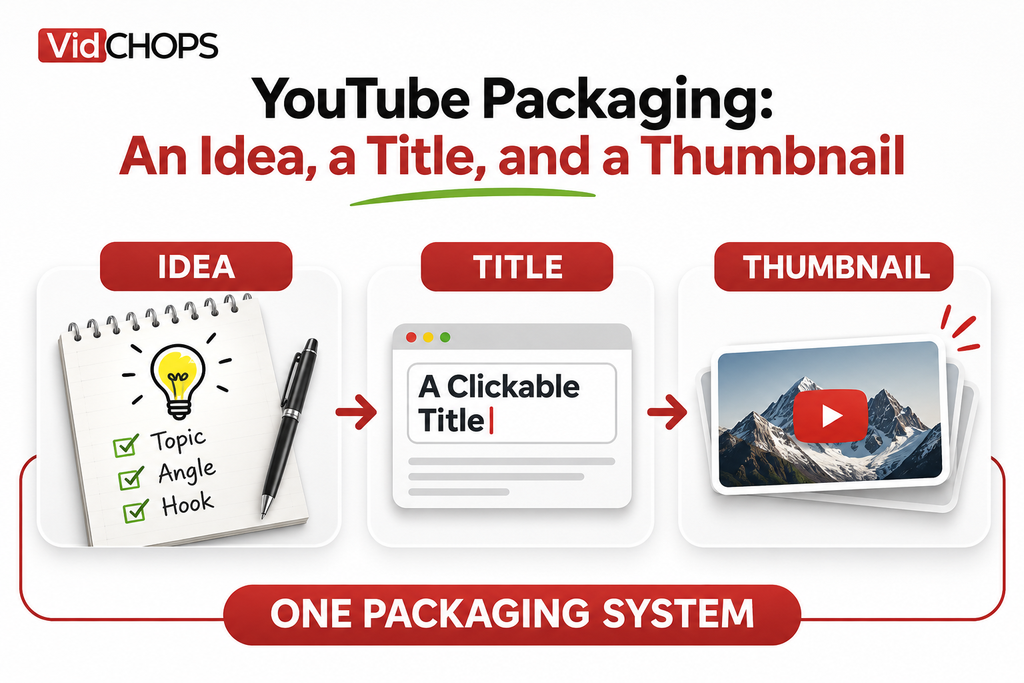
The idea sets the ceiling. If the concept is boring, no thumbnail saves it. Galloway’s model here is useful: there’s the total audience you could reach, there’s the ceiling your idea imposes on that, and then there’s your execution. Most creators obsess over execution and never notice they picked an idea with a low ceiling.
The title and thumbnail then have to complement each other, not repeat each other. If your title says “How Anyone Can Go Viral in 2026” and your thumbnail text says the same thing, you’ve wasted half your real estate. If the thumbnail says “This is the key,” you’ve created a gap the title didn’t fill, and the viewer has to click to close it.
And the thumbnail has one job above all others: be understood in a glance. Galloway’s test is whether someone scrolling at speed can look at it and immediately think “I get that, I want to watch that.” If it takes two seconds to parse, it’s already lost.
The 1-in-10 funnel: how good thumbnails actually get made
Here’s where most people’s mental model breaks. They think a good thumbnail is something you have. In reality, it’s something you select.
Galloway’s team runs what he calls the 1-in-10 funnel. For each client, they generate somewhere between 200 and 500 ideas per month. Those go through an elimination criteria — is it feasible, can we package it, does it hit our aspirational view target — which cuts them down to about ten. Those ten get a one-page treatment each: rough thumbnail sketch, rough title options, a logline. Then the team picks one.
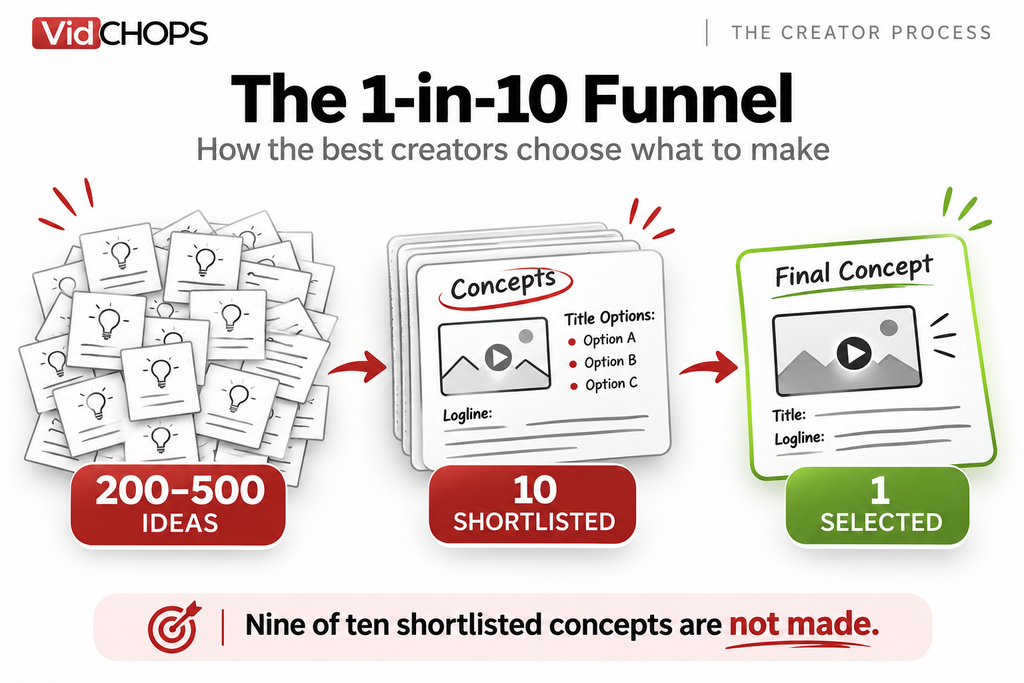
Nine of those ten will never be made.
The same logic applies to thumbnails specifically. Galloway’s minimum standard is three differentiated thumbnails per video, and on bigger projects his team has made 45 to 50. He’s said he used to have it written into client contracts as a non-negotiable: make three thumbnails per video or we won’t work with you.
And “differentiated” is doing real work in that sentence. He describes people making three thumbnails where the only change is the shirt colour — white, yellow, blue. That’s not three thumbnails. That’s one thumbnail with a filter.
The Red Bull example: what a 30-million-view thumbnail looks like
The clearest illustration of packaging as a discipline is a Red Bull video Galloway’s team worked on: world’s fastest camera drone versus an F1 car, with Max Verstappen driving.
It’s passed 30 million views.
Now, the obvious objection: “Of course that went viral, it’s a drone racing an F1 car with Verstappen in it.” And yes, the idea is strong. But Galloway’s point is that plenty of videos have all the ingredients and get nothing, because the packaging doesn’t do its job.
Look at what the thumbnail actually does:
- It’s a paused moment. The car and drone are at the start line, revving. You feel like you’re clicking to unpause the race. That’s the “click to unpause” principle — the image implies motion that hasn’t happened yet, and clicking is how you make it happen.
- Leading lines. The track runs to the horizon, pulling your eye toward the race itself.
- It’s clean. No clutter. No overlaid text fighting for space.
- Verstappen isn’t in it. One of the most famous drivers in the world, and they left him out, because the thumbnail didn’t need him.
That last point is the one most creators get wrong. They fill every pixel because they’re afraid of wasting space. The best thumbnails are usually the emptiest ones.
The uncomfortable truth about your editing budget
Let me put this in terms you can act on.
If you have 100 hours to make a video, Galloway’s recommendation is to put 10 to 20 hours into packaging. Not because packaging should be half your time — he explicitly says that would be insane — but because packaging is half the game, and 10–20% of your time is the minimum credible investment in something that determines half the outcome.
For a business owner, that translates to something like this:
- Don’t spend three hours colour-grading a video nobody clicks on.
- Do spend that time generating ten title options and briefing three thumbnail concepts.
- Don’t re-edit a video that’s underperforming on views.
- Do swap the thumbnail first and see what happens.
And if you’re paying someone, the same logic applies to money. A thumbnail designer costs a fraction of what an editor costs. If your budget is tight, the thumbnail is the better first hire — not because editing doesn’t matter, but because the thumbnail is upstream.
Where this argument breaks down
I’d be doing exactly what I criticise if I pretended this was universal. So here are the honest limits.
Packaging can’t save a bad idea. If the concept is genuinely uninteresting to your audience, a beautiful thumbnail just gets more people to a video they’ll leave. Galloway’s ceiling model is right: the idea sets the limit, and packaging only determines how much of that limit you reach.
Packaging can’t save a bad video. If people click and immediately leave, YouTube learns the video doesn’t satisfy, and it stops being promoted. A misleading thumbnail is the fastest way to damage a channel — you get the click, you lose the watch, and the algorithm notices.
Some channels genuinely are editing-led. If your entire value proposition is production quality — cinematic travel, high-end documentary, visual effects — then the edit is the product, and the thumbnail is just the door. But that’s a small minority of business channels.
And the data has limits. The 40x case study is one video, self-reported, with no control group. It’s a striking illustration of a principle, not proof of a repeatable multiplier. Treat it as a story that explains the mechanism, not a guarantee.
What to do differently this week
Five things, in order of leverage.
1. Audit your last ten thumbnails. Put them side by side at phone size. Can you tell what each video is about in one second? If not, that’s your problem, and it’s not an editing problem.
2. Write ten titles before you film anything. Not one. Ten. It takes fifteen minutes and it forces you to find the most interesting version of the idea rather than settling for the first one.
3. Brief your thumbnails before you shoot. Most creators film the video and then think about the thumbnail. Reverse it. Decide what images you need, then capture them on the day — from multiple angles, multiple expressions, multiple framings. Galloway’s team takes hundreds of photos per thumbnail shoot for exactly this reason.
4. Make three genuinely different thumbnails. Not three colour variants. Three different concepts. Then split-test them.
5. Change the thumbnail before you change anything else. If a video is underperforming, the thumbnail is the cheapest, fastest, highest-leverage variable you have. Try it before you touch the edit.
How VidChops fits into this
We’re an editing company, so it would be strange for us to tell you editing is irrelevant. It isn’t. But we’ve watched enough channels to know that the videos that take off are rarely the ones with the most polished edits — they’re the ones with the strongest packaging and a competent edit behind it.
That’s why our YT Helper service exists. Once your edit is done, your YT Helper uploads the video, designs two thumbnails and split-tests them against each other, writes the title, tags and description, and schedules it to go live. The whole point is that the packaging gets the same professional attention as the edit — because it’s worth more.
If you want to see what that looks like end to end, book a call and we’ll look at your last ten thumbnails with you. We’ll tell you honestly whether your bottleneck is packaging, editing, or the ideas themselves. Sometimes it’s not what people expect.
And if you’d rather start with the free stuff, our free resources page has guides on working with your editor and getting more out of your footage.
FAQ
What’s a good click-through rate on YouTube?
It depends entirely on where your impressions come from. Browse and suggested traffic typically runs lower than search traffic, and channels operating in bigger markets often have lower CTRs with far more total views. Galloway’s point is that CTR is a misleading metric to chase in isolation — a channel with a 4% CTR and a million impressions beats one with a 10% CTR and 50,000. Track views, not CTR.
How many thumbnails should I make per video?
Three, minimum, and they should be genuinely different concepts rather than variations of the same image. If you have the budget, more. Galloway’s team has made 45–50 for single videos.
Should I change the thumbnail on an underperforming video?
Yes — it’s the cheapest variable you have. But be disciplined about it. If a video is performing well, don’t touch it; good data beats no data. If it’s performing badly, you have bad data versus no data, and no data might be good. Make the change.
Does a better thumbnail mean I can skip the editing?
No. A thumbnail gets the click; the edit determines whether people stay. If people click and leave, YouTube stops promoting the video. Packaging and editing are sequential, not alternatives.
How much of my budget should go to thumbnails vs. editing?
If you’re time-constrained, put 10–20% of your production time into packaging. If you’re paying for help, a thumbnail designer is cheaper than an editor and sits further upstream — so it’s usually the better first hire.
Can I make good thumbnails myself?
Yes, if you’re systematic. The constraint isn’t design skill, it’s volume — most people make one thumbnail and ship it. If you commit to three concepts per video and actually test them, you’ll outperform people with better design tools and worse process.
A 20% better thumbnail can produce a 40x better result. A 20% better edit cannot, because the edit only matters to the people who already clicked.
That’s not an argument against editing. It’s an argument about order. Get the packaging right first, then invest in the edit. Do it the other way round and you’ll spend your best hours on the smallest audience.
Most creators have this backwards. That’s the opportunity.